





Welcome pack
500% + FS
Deposit boosts & free spins where available. T&Cs apply.
Promo
CREWWIN

Chaos Crew Games · Eva Chance
Can any Chaos Crew strategy beat the reels? Explore real bonus mechanics, misleading betting systems and practical risk information for all three games.
Angry cats, skulls and glitches: the Chaos Crew family looks like it escaped a basement gig. The maths is less rebellious. No spin pattern, lucky time of day or doubling system guarantees a win.
A useful strategy article explains the features and helps you avoid mistakes; it does not pretend to hack random outcomes.
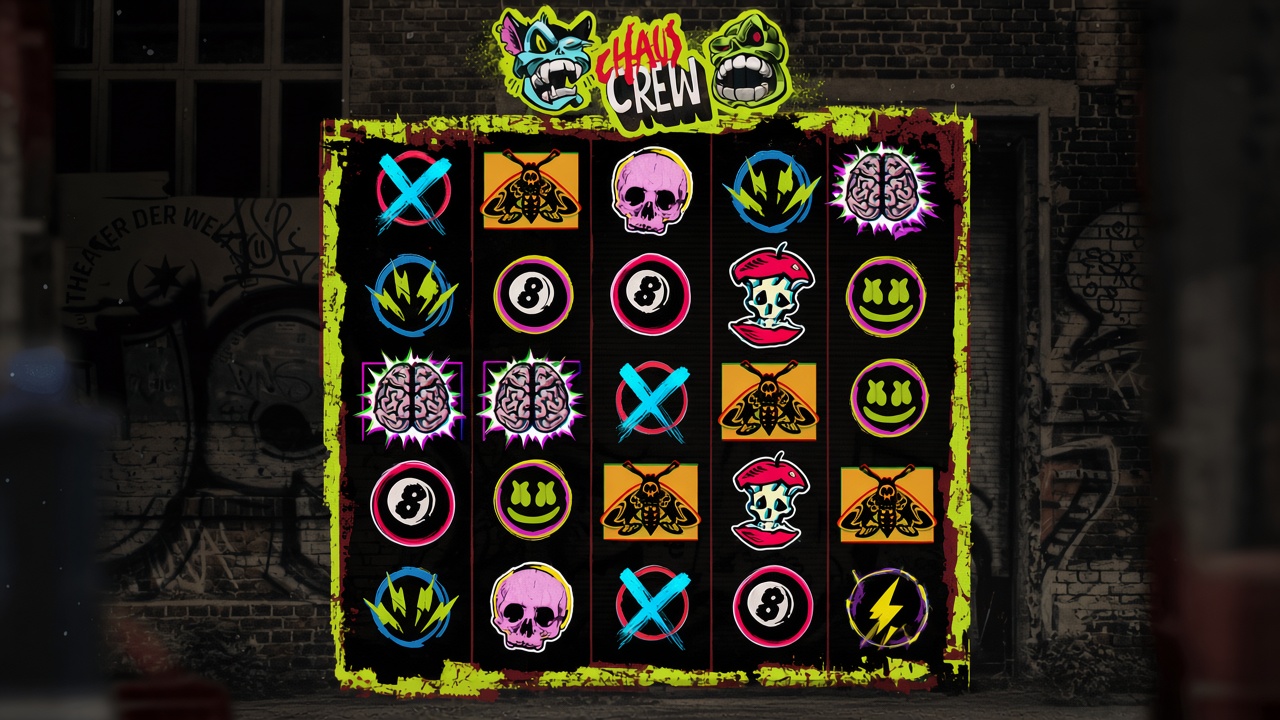
The first game centres on Cranky and Sketchy multipliers and a collection-style bonus. Learn when symbols contribute to qualifying wins and read the bonus rules instead of treating every dramatic animation as a payout.
The advertised 10,000x maximum is a ceiling, not a goal you can summon by stubbornness.
The sequel adds Epic Drop, Super Bonus and Best of Bonus. Some features can activate randomly and others have their own trigger conditions. There is no evidence that increasing your stake after a losing streak makes a bonus more likely.
Understand purchase costs and any different theoretical returns before deciding whether bonus features are appropriate for you.

The third release distinguishes bonuses by scatter count. Three, four and five scatters are associated with different feature routes. Knowing which is which helps you read the game—not predict the next round.
The Glitch Dog and upgrade systems give the bonus its personality; they do not turn it into a solvable puzzle.

Check the RTP configuration shown in the rules panel. Set an entertainment budget and a session time limit before you begin. Treat money spent as potentially lost and never increase wagers solely to recover previous losses.
You can learn the interface with virtual credits using our Chaos Crew demo guide.
If you want to learn the interface first, an authorised demo is the rehearsal room.
“A bonus is due after 100 spins”: not established by the previous losing run. “Night play pays more”: no reliable evidence. “Bonus Buy guarantees profit”: false. “Demo results predict real money”: false.
Popular claim
Reality
More spins make a bonus due
No reliable prediction
Larger bet fixes a losing streak
Increases financial exposure
Demo success forecasts cash wins
No
Rules knowledge
Improves understanding, not odds
The only dependable thing about an allegedly guaranteed slot strategy is that somebody probably wants to sell it to you.
Can you predict a Chaos Crew 3 bonus? No reliable method predicts random outcomes. Does switching stakes change the house edge? Not as a general strategy; consult the specific paytable for bet-specific rules. Which Chaos Crew should you try first? Whichever features you want to learn in a lawful, available demo.
Learn the chaos. Do not chase it.
The game rules explain what symbols do; a betting ritual claims to control when they arrive. That is the dividing line. Reading how a feature starts, how multipliers are aggregated and what ends a bonus round is useful knowledge. Counting “dead spins,” switching devices or increasing stakes after a loss is not a reliable way to alter a random result. A player can understand the reels perfectly and still finish a session down. Knowledge reduces confusion, not the mathematical house edge.
Before playing, decide whether this is entertainment you can afford, establish a maximum loss and time limit, and choose whether the demo already answers your curiosity. Avoid setting a win target that quietly becomes an excuse to chase losses. When looking at different casinos, compare the exact RTP and published rules instead of treating every version as identical. If you are frustrated or trying to repair earlier losses, the productive next move is to stop rather than search for one more “secret” strategy.
Before opening a real-money session, separate things you can control from things you cannot. You can control whether you play at all, how much money you expose, how long you spend, and whether you have read the feature rules. You cannot control the outcome selected by the random-number system or force a scatter combination to occur. This distinction sounds painfully obvious until the screen fills with near misses and your brain starts building a story about momentum. Use a simple pre-session checklist: identify the exact title, inspect the information panel, check the RTP version, find any available safer-gambling controls and decide on a firm entertainment budget. If any of these details remain unclear, you have no obligation to play. The most useful strategy sometimes consists of shutting the tab and keeping your money.
A common piece of online advice tells you to spin a fixed number of times, then increase the stake because a bonus is supposedly close. The argument smuggles in a false assumption: that independent random events keep a memory of previous disappointments and must rebalance during your session. A sequence of losing outcomes can feel meaningful, particularly when bonus animations create near-misses. Feeling meaningful does not make it predictive. The game's underlying probability rules have not transformed because your personal record looks unlucky. Unless an officially documented mechanic explicitly carries state from one spin to another, you should not assume that the reel outcomes follow a recovery schedule. Saving a pattern in a spreadsheet may make it easier to remember your session, but it does not turn randomness into a forecast.
Some players favour a flat stake, while others raise and lower wagers according to how the session feels. The financial effect is straightforward: larger stakes expose more money on each spin. Neither method changes the mathematical return configured for the game merely because the betting pattern sounds clever. A progressive system can be especially dangerous during a losing run, as losses compound and bankroll limits arrive faster than the theory suggests. If a game has distinct feature rules tied to certain stake levels, those conditions should be verified in its official paytable; do not infer them from rumours. From a harm-minimisation point of view, a predefined budget is easier to follow than a plan that requires ever-larger bets to chase previous results. The excitement of the mechanic is not a reason to rewrite the budget mid-session.
Read the actual published variants in the Chaos Crew RTP guide.
A bonus purchase can be marketed as a fast track to the exciting part of the slot. Fast is not the same as favourable. Before buying, identify the cost as a multiple of the base stake, the rules for the purchased round and whether the game publishes a separate theoretical return for that feature. The option may be restricted or removed in particular markets, so never assume a video recorded elsewhere represents what is legally available to you. Most importantly, a purchased bonus can return less than its price. A dramatic feature screen should not be interpreted as a receipt for profit. If you want a complete explanation of each title's options, follow the dedicated Bonus Buy page rather than relying on this strategy overview. It covers the mechanics; this page addresses the decision errors people make around them.
Demo mode is a learning environment, not a machine for predicting the next cash session. Use it to recognise the original game's multiplier symbols, watch the sequel's Epic Drop sequence and understand which scatter combinations route to which bonus in Chaos Crew 3. Take notes on where the paytable lives, how the game explains its options and what you find confusing. Do not treat a short run of strong demo payouts as evidence that a real-money version is warming up. You may encounter different configurations or availability restrictions, so always check the rules shown in the specific environment. If the original game is not legitimately accessible as an embedded demo, a written walkthrough is preferable to an unlicensed imitation. Knowing how a screen works is useful. Assuming the next screen must pay is not.
Streaming clips and highlight reels are excellent at showing rare events and terrible at conveying their base rates. Nobody uploads every dull spin in a thousand-spin session with the same enthusiasm as a huge multiplier combination. That selective editing is not necessarily malicious; it is how entertainment media works. Trouble begins when a montage is presented as evidence that a specific betting sequence guarantees success. Ask what the clip leaves out: total stakes, session length, losses before the feature, the RTP version and whether the sequence was real-money or demo play. If that information is absent, treat the footage as a demonstration that an event can occur, not as a plan for reproducing it. No number of excited reaction faces turns a selected highlight into a controlled statistical test.
In many games, skill changes the probability of success. In a conventional random-number slot, learning the rules usually does not change the mathematical edge. You can become very good at explaining why four scatters produce a different bonus from three, but you cannot become skilled at making the next random scatter land. This doesn't make learning pointless. It makes the benefit informational rather than financial: you can understand what a purchase does, recognise misleading claims and decide whether the entertainment fits your preferences. It is better to describe that benefit accurately than to promise a strategy that the slot's design does not support. Punk attitude is fine. Inventing a secret mathematics hack is just advertising in a studded jacket.
A strategy for a random slot cannot be a sequence of instructions that reliably forces favourable reels. It can, however, be a plan for approaching the game as a finite entertainment expense. Begin by learning which features exist, how their symbols interact and what mathematical information the provider publishes. Then decide what amount of time and money you can spend without needing the outcome to rescue your finances. If you cannot comfortably lose the budget, the appropriate strategy is not to gamble.
This may sound less exciting than a “secret five-step win method,” but it is honest and useful. A player who understands the paytable is less likely to mistake a decorative flash for a payout or a large multiplier for an automatic win. A player who sets limits before starting is also less exposed to the emotional trap of raising stakes after losses. None of this defeats the house edge; it helps keep the experience within boundaries.
It isn't defined by a guaranteed profit. A better session is one in which the player understands what product they are using, recognises the main mechanics, stays within a pre-set entertainment limit and can stop as planned. For the original, this means recognising Cranky and Sketchy symbols and how the bonus values are collected. For Chaos Crew 2, it includes differentiating Epic Drop, the Super Bonus and Best of Bonus. For the third, it means understanding the three scatter-triggered bonus paths.
We examine purchase options separately in our Chaos Crew Bonus Buy guide.
The distinction between comprehension and prediction should be repeated because casino myths rely on blurring it. Knowing why an Epic Drop paid a particular amount doesn't help forecast the next Epic Drop. Understanding the CHAOS sequence on a reel doesn't let you summon it through timing. You can become more informed about the software without becoming more powerful over the random events.

Suppose one officially published Chaos Crew 2 version has 96.27% RTP and another has 88.28%. Those are materially different theoretical returns. Comparing them can inform a choice about which configured game to avoid or analyse further, but it does not imply a guaranteed payout over the next hundred spins. Variance may be large relative to the average during an individual session.
Strategy pages often misuse RTP by suggesting players can “collect” the missing percentage or time a session for better returns. That is not how a random mathematical model works. Check the actual version, understand the difference between RTP and volatility, and never interpret a previous loss as a credit you are owed by the reels.
A feature purchase can compress a large amount of stake into a single decision. It may be convenient for seeing a particular mechanic, and the feature may have its own stated mathematics. It is not a method of purchasing a positive outcome. If the price is a large multiple of your usual spin stake, the risk to your session budget is correspondingly concentrated.
Before considering such a purchase, distinguish its advertised feature name from its cost and conditions. Chaos Crew 2 has multiple bonus concepts, and Chaos Crew 3 has distinct scatter-triggered bonuses; these do not translate automatically into identical purchasable options in every market. Where feature buy-ins are restricted, availability shouldn't be assumed. “Skip the waiting” is a description of convenience, not an improvement in expected profitability.
Martingale-style systems increase a wager after losses in the hope that a later win will recover earlier losses. The arithmetic becomes dangerous quickly: doubling a bet repeatedly produces exposures that grow faster than most people appreciate, while account balances and stake limits remain finite. More importantly, the previous spins do not change the mathematical advantage held by the game. Doubling a negative expectation doesn't convert it into a reliable positive one.
Counting spins since the last bonus is another common myth. A diary can help you measure what you spent and how often you played, but it cannot reliably predict the next random bonus. Charts that call a slot “due” after a dry streak usually describe the gambler's fallacy in a nicer typeface. The reels have no memory of the personal story you constructed around them.
Eva Chance is a fan of unconventional real-money games, strange characters and unmistakable visual design. Chaos Crew is one of her favourite series to study. Her editorial approach separates verified mechanics from marketing claims and never promises that a slot strategy can control random outcomes.
Independent editorial guide. Gambling is financially risky; access real-money gambling only where lawful, and never risk money you cannot afford to lose.