





Welcome pack
500% + FS
Deposit boosts & free spins where available. T&Cs apply.
Promo
CREWWIN

Chaos Crew Games · Eva Chance
Chaos Crew slot explained: compare the three Hacksaw games, special symbols, features, RTP configurations and what makes each release different.
These are not quiet, minimalist slots. Punk illustrations, loud characters and multiplier-oriented play tie the series together. Still, all three games differ in the way bonus features are triggered and calculated.
This editorial overview explains the actual slot mechanics. Independent player opinions belong in our separate player reviews page.

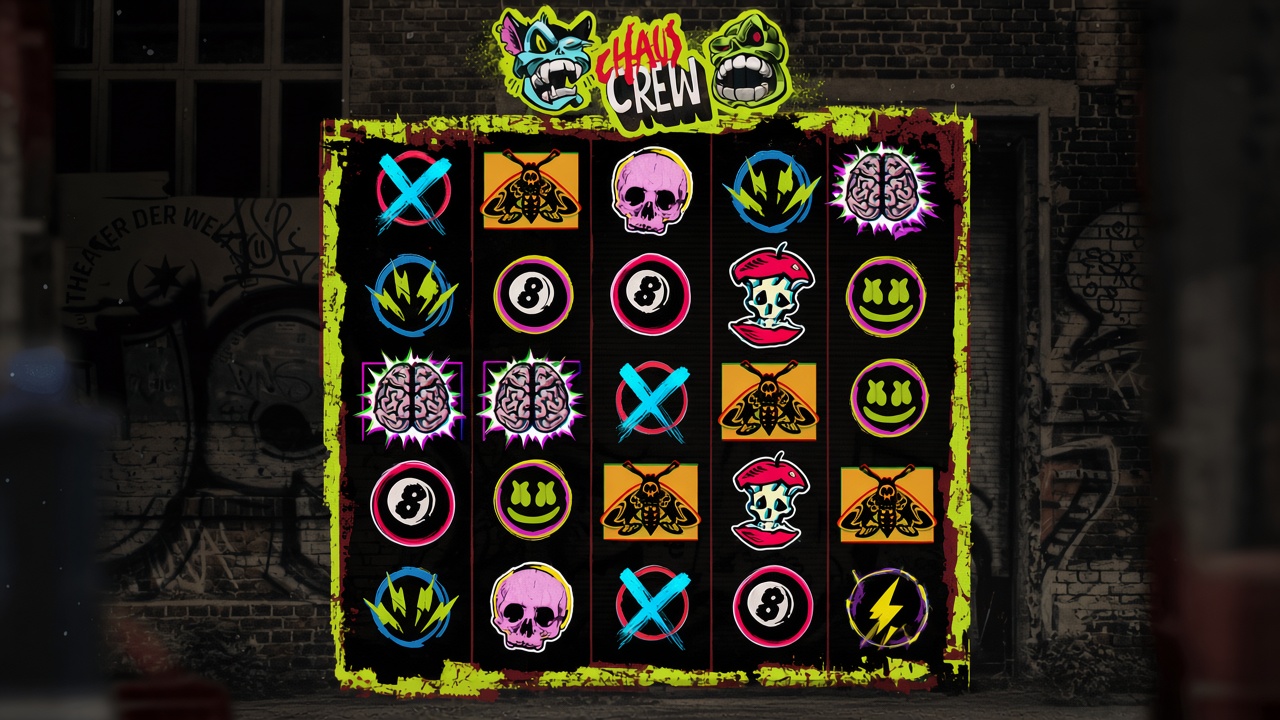
The original game uses five reels and five rows. The character multipliers can affect qualifying wins and the bonus collects multiplier values before producing a payout. Hacksaw Gaming advertises a maximum win of 10,000x.
The sequel moves into Epic Drop territory. Multipliers can appear as a random base-game feature; bonus variants add extra ways for the game to generate outcomes. Hacksaw advertises a 20,000x maximum win. Do not confuse that advertised ceiling with an expected result.
The third entry adds bonus routes involving three, four and five scatter symbols. That makes its feature tree particularly important to understand. Read the current rules panel for the exact game version rather than trusting a screenshot from another operator.
All the spectacle sits on top of a mathematical model. Volatility describes the shape of possible outcomes; RTP describes a long-run theoretical return and can vary by released configuration. Neither tells you what the next spin will do.
If you want to understand the original multiplier concept, start with the first game. Interested in an expanded bonus line-up? Study the second. Curious about the three/four/five-scatter split? The third is your rabbit hole. For a no-risk introduction, choose demo play where it is available.
You can explore the controls and paytables without wagering in our Chaos Crew demo guide.
It is easy to be distracted by violent colour, animated characters and multiplier effects. Start instead with the paytable and the actual rules. Inspect how paylines or winning combinations are defined, which symbols have multiplier properties and whether those values apply only to a particular win or to a running bonus total. The point is not to memorise every animation but to understand where payouts can and cannot come from. Some mechanics look similar across the trilogy but operate differently, which is exactly why comparing all three on one page is useful.
A practical comparison begins with four questions: what features can appear in the base game, what activates each bonus, what happens during that bonus, and which RTP variant is being offered? Then look at volatility and published maximum win, remembering that both describe characteristics rather than future results. Someone who enjoys learning mechanics may prefer the original’s more straightforward structure; someone drawn to elaborate feature pathways may be curious about later releases. That is a difference in design preference, not an evidence-based prediction of profit.
| Question | What the editorial review checks |
|---|---|
| Mechanics | Paylines / qualifying combinations / special symbols |
| User experience | Visual clarity, sound, bonus complexity |
| Mathematics | Source-backed RTP, volatility, max-win caveats |
A video slot is a game of predetermined rules and random outcomes. In Chaos Crew, the design puts five reels and five rows on the screen and surrounds the symbol grid with a cast of characters. A player selects an eligible stake, starts a spin and receives an outcome governed by the game's rules. Payline wins and special symbols have distinct jobs. The most common mistake is treating any dramatic symbol animation as proof of a large payout. The rulebook, not the animation, tells you which combinations count.
The original game's public Hacksaw page creates an additional editorial challenge: the description says 15 paylines while its Game Data block lists 19. We should not silently choose one number and repeat it across dozens of pages. Until a dated official paytable or live game information screen resolves the discrepancy, a careful review can confirm the 5x5 layout and explain paylines without printing an unverified fixed count. This is how a small independent site earns trust: by admitting when a source itself is inconsistent.
The original Chaos Crew leans hard into character-based multipliers. Cranky Cat matters because the wild multiplier can influence a qualifying combination; several eligible cats together can change its value further. The bonus uses collected multiplier symbols and Epic multiplier effects. You are not simply watching a line of identical icons disappear into a payout total. You are following a two-layer system: ordinary winning combinations in the base game and multiplier collection in the dedicated feature.
That still leaves the essential limitation intact. Knowing the mechanic improves comprehension, not probability. The player cannot arrange a favourable Cranky position by tapping the screen at a lucky moment or changing the duration of a spin animation. A useful review gives enough detail for readers to recognise the mechanic, then steps away from claims about secret influence. When a page promises to “master” the reel outcomes, it has crossed from explanation into fiction.
Chaos Crew 2 enlarges the original formula with Epic Drop and a broader bonus structure. Hacksaw's official description specifies a 5x5 game with 19 paylines. A random Epic Drop in the base game can place a minimum of five multiplier symbols; the Super Bonus can be entered with four scatters and starts with an enhanced drop. Best of Bonus compares the results of three corresponding bonus executions. These are different feature paths, not three names for exactly the same spin.
The sequel also advertises a 20,000x maximum win, compared with the original's 10,000x. That makes a memorable specification, but it does not prove that a player's next session has better odds. For a genuine comparison, check the game's current RTP configuration as well as the cost of any optional feature. A more elaborate slot can be aesthetically more interesting while maintaining a substantial house advantage. Neither the soundtrack nor the number printed next to MAX WIN settles the matter.
For the provider-listed return configurations, read the separate Chaos Crew RTP comparison.
Chaos Crew 3 adds a new visual vocabulary: Glitch Dog symbols, the word CHAOS across a row, Reel Multipliers and a Chaos Upgrade that affects nearby symbols in one bonus mode. The original game's collect mechanic is still part of the family tree, but the specific ways multipliers enter and accumulate have changed. The public provider page is especially clear about the number of FS scatters associated with each bonus path: three for CTRL + ALT + CHAOS, four for The Korrupted K9 and five for An Epic Glitch!
The five-scatter feature is not proof of a guaranteed enormous result. It starts with specified special symbols according to the rules, and the random outcome then plays out. Likewise, a promotional capture of one massive payout tells you that a result was recorded, not how often it can occur. If you're comparing three generations, compare verified trigger rules and theoretical returns—not the emotional intensity of a YouTube thumbnail.
Imagine explaining the games to a friend who has never played one. The original is the easiest introduction to Cranky, Sketchy and the idea of stacking multiplier values. Chaos Crew 2 is the more crowded instrument panel: additional features, a Super Bonus and a Best of Bonus variant. Chaos Crew 3 is a glitch festival with several bonus paths and position-sensitive symbol interactions. That summary is useful because it highlights the nature of the design without pretending to rank profitability.
Our editorial evaluation therefore has two tracks. One is descriptive: visuals, sound, clarity, pace and the originality of the features. The other is mathematical: published RTP settings, advertised maximum wins, stated volatility and any relevant version differences. Both tracks matter. Mixing them creates bad reviews, such as calling the newest game “safest” because its artwork feels less intimidating. Nothing about a cartoon cat makes a wager safe.
You do not need to memorise every symbol on your first visit. Identify the ordinary paying symbols, then find the special ones that can act as wilds, multipliers, scatters or bonus collectors. Next, look for the exact trigger conditions and any separate feature rules. Finally, note the game's configured RTP if the information panel provides it. That basic reading order turns a busy interface into a small set of understandable operations.
Avoid using an unverified third-party specification as though it outranks the game itself. A review site may confuse variants, dates or mechanics. The rules attached to the actual game session are the relevant operational reference for a player. Our role is to translate them into accessible English, not pretend to replace the underlying technical documentation.
An editorial slot review is our assessment of the game's design, features, clarity and mathematical disclosures. It isn't a compilation of player comments, and it isn't a recommendation to stake more money. We describe what the game does, compare its unusual elements with the other releases and point readers to official rules for facts that depend on configuration. Eva can have strong opinions about the art without inventing evidence about expected payouts. That separation makes the review useful to people who are curious about the software but have no intention of betting.
Our Chaos Crew maximum-win breakdown explains what headline multiplier ceilings do and do not mean.
A good review also tells you when it was researched, which sources were consulted and what remains uncertain. We prefer “the public provider page lists several RTP variants” over “this slot always pays 96%.” We prefer a clearly labelled disputed line count to a copied specification that may be wrong. The result should feel like a serious game review in a leather jacket, not a casino sales page in costume.
The series makes a deliberate break from the standard casino visual library of jewels, treasure and ancient ruins. Characters feel drawn with a marker rather than polished to a corporate shine, and the typography and palette support the attitude. That's a real strength for people who value visual identity. However, a crowded screen can make bonus mechanics less immediately legible, particularly on smaller displays. Readers should be encouraged to locate the paytable and understand the symbols rather than rely on animation alone.
Sound contributes to the personality, but not everyone wants a full-volume soundtrack during a long session. Game settings, mute controls and accessibility should be discussed as practical factors. An engaging slot can still be a poor fit for someone who prefers quiet, predictable presentation or finds fast visual effects uncomfortable. A fair review makes room for that possibility instead of telling every visitor they'll love the chaos.
The original can be a convenient entry point for learning the series, but high volatility does not make it an ideal financial choice for beginners. The core mechanics are explainable, yet the outcome distribution may produce frustrating dry spells. Beginners should not be invited to learn through real losses when free instructional materials are available. A demo can be a rehearsal for understanding buttons and symbols; it does not rehearse the future results of a separate cash session.
The sequels add more concepts, which can increase the learning curve. For someone interested in design history, starting with the original and progressing through the sequels is logical. For someone mainly interested in a particular feature, beginning with the relevant game's official rules is equally reasonable. We do not rank the games by supposed ease of winning because that would require evidence the visual differences cannot supply.
Is Chaos Crew 1 a separate title? It is the usual informal name for the original Chaos Crew. Is Chaos Crew a crash game? No, these are reel-based video slots rather than cash-out-timing crash games. Is Chaos Crew 3 simply an update of Chaos Crew 2? No, the third main title has its own advertised bonus modes and symbol interactions. Is a large multiplier always a payout? No, the relevant qualifying rules must be met.
Does having three instalments mean there are three separate developer websites? No; the recognised provider is Hacksaw Gaming, while this independent website explains the series. Can a game be offered with different RTP settings? Yes, at least the first two publicly list variants. These answers belong in a review because they help a newcomer interpret what the series actually is, without needing a maze of thin pages.
Eva Chance is a fan of unconventional real-money games, strange characters and unmistakable visual design. Chaos Crew is one of her favourite series to study. Her editorial approach separates verified mechanics from marketing claims and never promises that a slot strategy can control random outcomes.
Independent editorial guide. Gambling is financially risky; access real-money gambling only where lawful, and never risk money you cannot afford to lose.